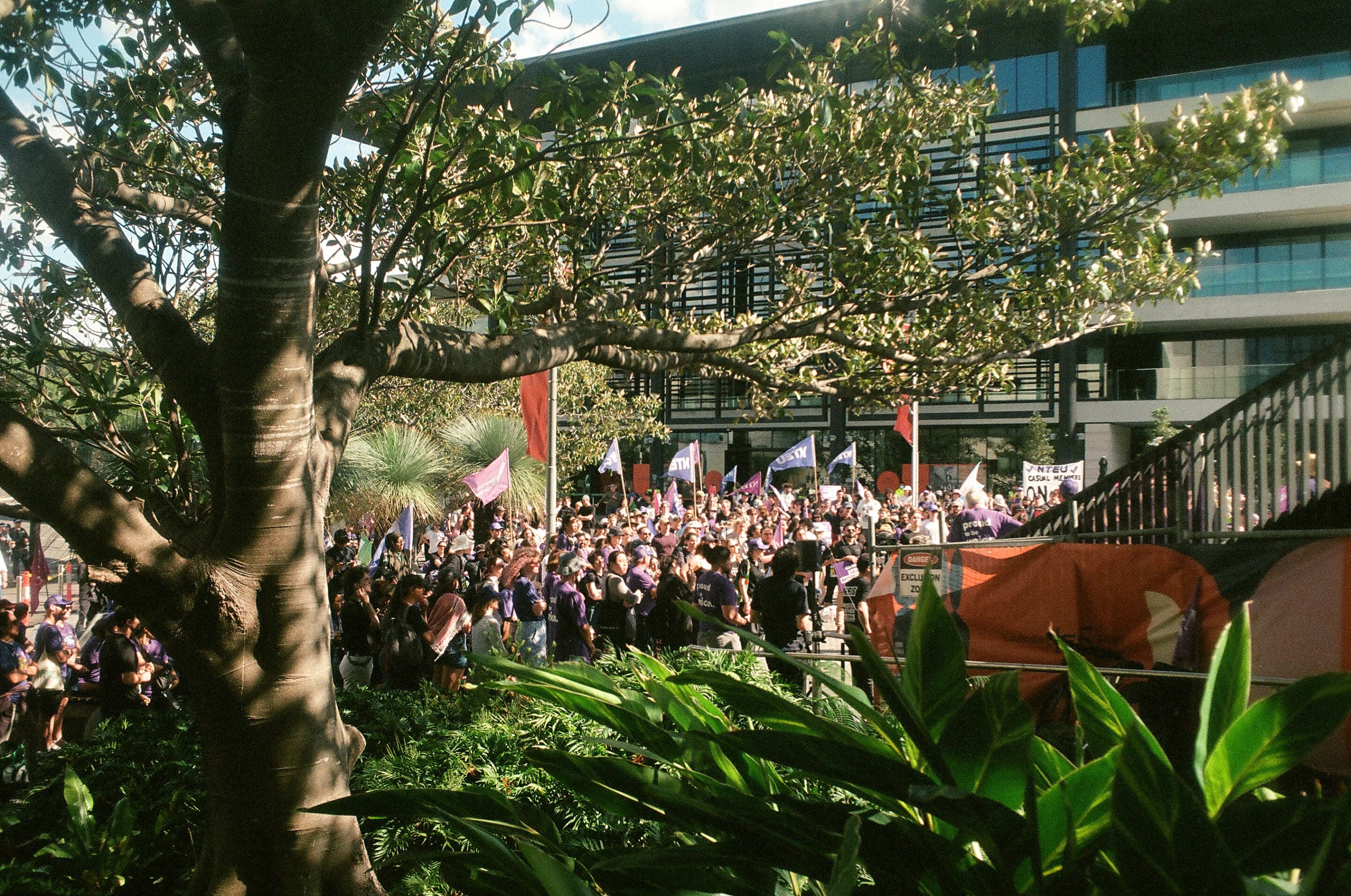

Week 9: 13/15 July
Summary
The latest bargaining round was dominated by significant disagreements over Artificial Intelligence (AI) and Academic and Intellectual Freedom, with the NTEU suggesting that management’s responses represented a retreat from genuine bargaining. On AI, management rejected the union’s proposed protections, instead emphasising policy-based governance and limited consultation through existing mechanisms. On AI, management rejected not only clauses we expected to have to bargain on, but also the most basic protections we expected to be mutually agreeable, coming back instead with a proposal that was entirely insubstantial. The union criticised this approach as providing no enforceable safeguards for staff while allowing management maximum flexibility to expand AI use alongside weakened change management processes.
The union also tabled its final major claim on improving security for fixed-term staff, proposing tighter limits on fixed-term employment, longer notice periods, stronger pathways to continuing employment, and redeployment rights. While management rejected the redeployment proposal, it agreed to respond to the remaining claims.
Management presented a package of leave proposals in response to multiple separate leave proposals tabled by the NTEU and CPSU, including additional gender transition leave, expanded domestic violence leave for casuals, disability-related leave flexibility, and updated provisions for carers and emergency service leave. The NTEU will consider this in line with our existing claims and our expressed parental leave preferences.
Management also rejected almost all of the union’s proposals to strengthen academic and intellectual freedom, instead introducing additional workplace health and safety language that the NTEU argues would further constrain free inquiry.
Other discussions covered pay and classification issues for veterinary staff, casual pay rates, and planning for an intensified bargaining schedule in August, where negotiations will focus on management’s responses across key outstanding claims, including disability, workloads, AI, decasualisation and professional staff reforms.
Pushing Back two key matters
Following the last bargaining session, the NTEU received responses on two of our important proposals: Artificial Intelligence and Freedom of Expression. The first was simply a complete rejection of the NTEU proposal, and the substitution with six points that can be summarised as:
- AI is core to the work of the University
- Management will govern AI in a policy
- Staff can raise concerns about the technology through established processes.
Management’s response on Freedom of Expression was to reject almost all the substantive proposals of the Union, and to include additional wording that would reduce academic and intellectual freedom on campus.In response, at the start of bargaining this week, the NTEU made a brief statement to the effect that the
AI clause and the Freedom of Expression responses by management represented the antithesis of bargaining; in that they were either so insubstantial (AI) or retrograde (Academic/Intellectual Freedom) as to imply a lack of genuine interest in reaching agreement by the end of the year.
The Tuesday morning session on AI was difficult, with Management displaying an aggressive position from the outset. Management feigned surprise when we expressed to them that — having rejected all of our proposals – our membership and University staff in general, may be interested to know why even modest safeguards around AI decision-making were rejected.
It is clear that management want to retain maximal freedom of action to introduce new AI systems, as when, and how they see fit (their favourite word for the session was “agile”), and exclude unions and staff from the process of development and introduction. Concerns about the implications of AI for staff and employment were shunted towards references to change-management provisions – something we note that management want to gut in their proposal from the previous session.
This points to a grim managerial view of the future – maximal AI adoption with faster redundancy processes – less of a University and more of a massive data centre.
The Union asked management to explain how each of their proposed clauses could provide protections to staff – they could not. It became obvious that the extent of protections management is willing to commit to is a commitment to talk about AI at the existing Joint Consultative Committee – something the union can already do.
This – often techy — set of interactions came to a head before lunch, management undertaking to bring a revision back to the table. It appears clear that this issue will be an ongoing and important fight.
Union puts its claim for fixed-term precarious staff
The NTEU explained the details of our last substantive claim this session – improvements for protections for fixed-term staff. There are a lot of fixed-term staff at the University, particularly given our high research profile. Many of these staff members face rolling contracts that limit security and their ability to access housing loans, for example. Short term contracts also cause problems beyond the disadvantages for the staff directly affected, as the insecurity of these roles makes it more difficult to attract new staff members to areas of the university where these contracts are often utilised.
The Union has been developing our members’ group which works on fixed-term insecurity over the last few years, and this group will be an important driver for improvements.
At the table the NTEU’s proposed claims to assist these staff included:
- reducing the categories of staff that can be put on fixed-term contracts to align with the underlying higher education award,
- creating a standard five-week notification period for the end of a contract,
- creating key clauses that would lead to the use of continuing contracts where the work being undertaken is reasonably expected to be ongoing, and in instances where the work is not ongoing, to give staff the option of a funding contingent role or a fixed term role, and
- creating a redeployment process for fixed-term and funding contingent continuing employees.
Management rejected the final proposal at the table, but undertook to respond to the other items put forward.
Management offer of leave
While leave issues sat within a range of claims, Management have put forward a “comprehensive”* response on leave:
- An additional 10 days per year (non-accruing) for gender transition (not accessible by casual staff),
- An increase from 10 to 20 days from existing personal leave assessable for caring responsibilities,
- 2 days available from personal leave for charitable activities,
- Changes allowing request for additional leave from the head of HR before leave balances are fully expended for people with disabilities and/or chronic health conditions,
- Expansion of domestic violence leave of 20 days to casual staff where they are rostered to workloads,
- Updating of wording around parenting orders,
- Expansion of emergency service leave in the case of declared national or state emergencies, and
- The ability of union representativesto attend to their industrial duties without needing to apply for leave.
This was presented as a first and final package by Management.
The NTEU notes that we are yet to fully articulate our position on parental leave, and will fold that into our response to this set of proposals. We have reserved the right to consider the relationship between these proposals and our associated claims around disability and gender transition.
* this excludes those matters discussed in the last update on Aboriginal and Torres Strait Islander matters.
Academic and Intellectual Freedom
Management has rejected our claims to remove ambiguous language that diminishes the protections afforded by this section of the EA, and to insert protections against non-disciplinary forms of adverse action for exercising academic and intellectual freedom rights. They have also rejected the NTEU position to clarify the use of university space for freedom of expression purposes. Their response to our proposed improvements to this part of the Agreement has been the aggressive insertion of WH&S language.
While the NTEU supports – indeed the Union movement is the progenitor of workplace safety laws – WH&S protections, these are general protections and the inclusion specifically within the area of academic and intellectual freedom represents a further potential limitation of these core values of free inquiry.
The Union pointed out that management – having not put this item in their version of the Log of Claims – was freelancing broadly and could not really justify the inclusion of this provision in the clause. Management did include a variation of our proposal about the protection from disciplinary procedures for staff undertaking protected speech, and the union is considering if their form of working provides the protection in our original proposal.
Schedule 6 and Schedule 1
The remainder of bargaining was largely taken up with the CPSUs proposals – supported by the NTEU – for improvements to Schedule 6: these proposals would draw up the payment for vet nurses at the University animal hospital and also make improvements to callouts. Management appears resistant to the proposal, which would allow staff in the hospital to have their qualifications recognised in a HEO level equivalent to that of similar qualifications in other parts of the University.
Management has taken this claim away for consideration, however, and this does not represent a blanket rejection at this time.
Schedule 1 (casual pay rates) was also discussed and will come back to the table soon – management needs to respond to the questions asked by our Subject Matter Experts in the last working group meeting before this occurs, however.
Coming Up
There will now be a gap of two weeks before the next bargaining session, but the next session will see bargaining back-to-back over the first two weeks of August to make up for the gap.
As the NTEU has tabled all its substantial matters (with one area to be folded into the discussion of leave), the Union wants to shift into substantive and concrete bargaining from the next sessions. As such the upcoming agenda for discussions includes:
- Consideration of Management’s response to our Disability and Chronic Health claim;
- Consideration of the Leave offer of management
- Gender Affirmation matters
- AI
- Freedom of Expression
- Management’s proposals on professional staff (broad-banding pilot and secondments)
- Academic workloads
- Decasualisation