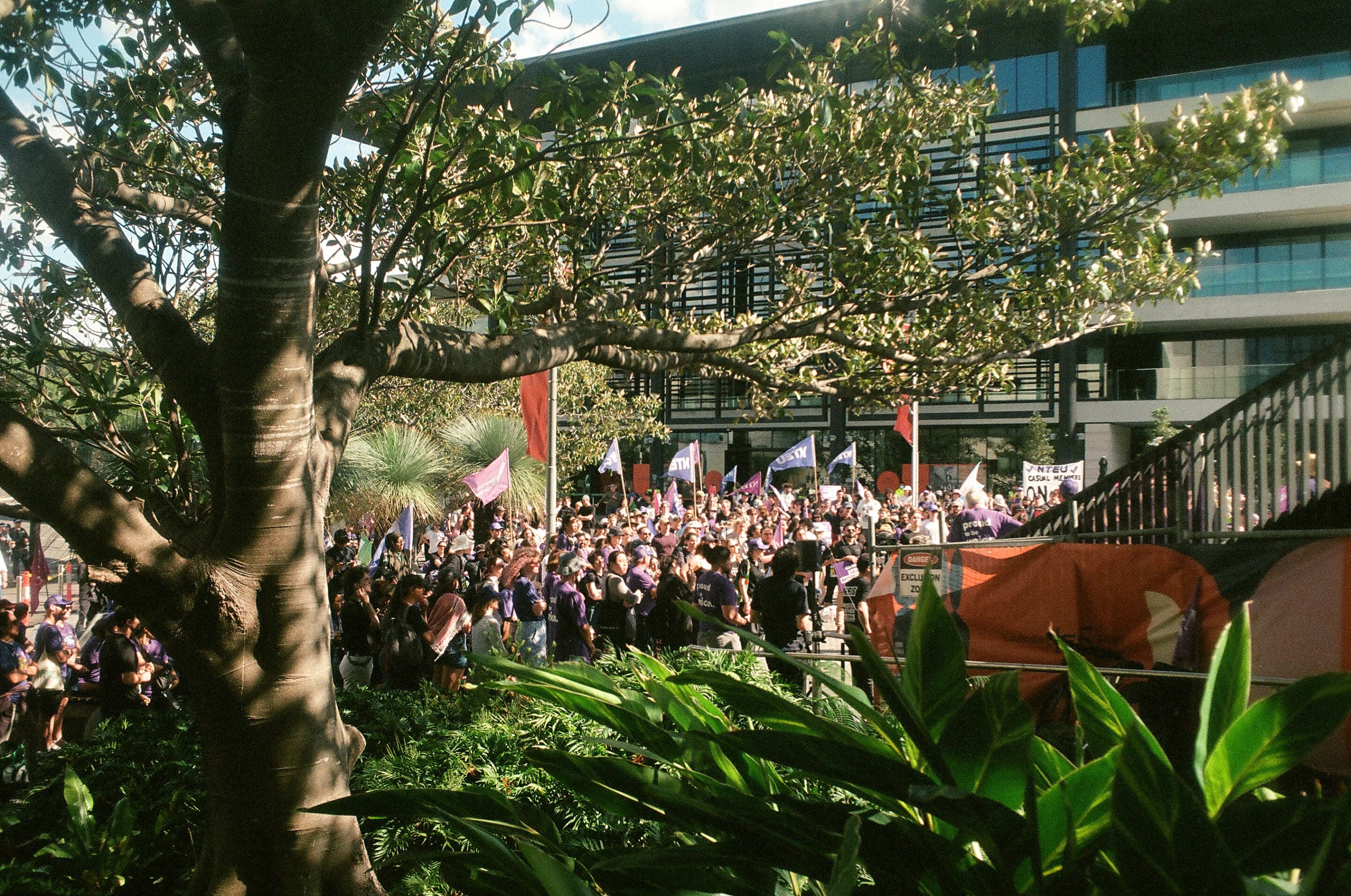

Week 10: 4/5 August
Summary
This week of bargaining is part of a two-week block that contains a lot of key matters on the agenda. Members are advised to pay close attention to Union communications, as the issues and position of the parties might develop rapidly. A case in point is the first item on the agenda of Tuesday’s session.
Tuesday 4th: A busy day
The NTEU was glad to get back to the bargaining table following a two-week break to ask Management a lot of questions about their response to our detailed proposals to modernise clauses related to disability and chronic health conditions. Some members will have seen our briefing on Management’s response that gutted our recommendations.
Members who had attended the briefing provided the Bargaining Team with very useful feedback on their concerns and disappointment about this response, and the team were able to take that to the table.
In the morning session we saw a range of movement from Management and a series of concessions made. Exact wording and finalisation remains, but it would appear that:
- Management agreed to name this section “Lived Experience of Disability and Chronic Health Conditions”, and include in definitions a statement indicating that, for the avoidance of doubt, disability where mentioned in the Agreement will encompass chronic health conditions (or words to that effect); and
- Management will redraft their clauses on the basis of discussion at the table, to include provisions related to optional local implementation plans for the DIAP (Disability Inclusion Action Plan), the development and launch of a disability passport, and assurance that leave taken because of disability and chronic health conditions is not included in any calculations under clause 270(b (ii) of the Agreement (to determine whether staff member has taken five periods of leave without providing acceptable documentation in the last 12 months).
Management has also agreed to put into the Agreement a clear managerial requirement for at-hire and refresher training for working with people with disabilities and/or chronic health conditions (*see below also).
Related to these key issues was a discussion of union proposals to provide greater staff protections around the use of Independent Medical Examiners (IMEs). IMEs are used where there are concerns that ill health prevents people being able to undertake their work. In extreme cases, negative findings by IMEs can lead to medical termination of employment, and so – while the number of cases of IMEs being used annually is low – the Union takes their use with the utmost seriousness.
While Management retains their resistance to lengthening the number of annual sick days that “trigger” the possible use of an IME, it has given concessions that an additional trigger will need to be cited in addition to days taken (such as safety to the worker, or incapacity to undertake the role) in addition to these trigger days. The Union and Management have further discussed the introduction of clauses in line with our proposals to use where possible a staff member’s own medical advisors over IMEs (for which the University would bear the cost), and to consider the use of appropriate workplace accommodations over medical terminations.
Matters related to gender affirmation (not including leave, which will come to the table next week) were discussed with in-principle agreement reached regarding the provision of appropriate bathrooms and facilities. The exact wording on these elements will be developed. In a related discussion, the provision of breastfeeding and comfort stations in the Agreement continues with Management.
*In addition, in a compromise position, management has included gender awareness training as with disability and chronic conditions to be included for managers. This is a different formulation than that originally proposed by the Union (all managers versus a nomination), but the Union feels that this meets the aims of our claim.
Noting that the Union has won in-principle agreement on workload review improvements previously, the parties returned to talk in depth about unfilled roles. Readers will recall that another key aspect of professional staff workloads is where roles are unfilled, with work spilling over to remaining staff. The Union and Management have back-and-forthed on this topic over a number of sessions, with the Union presenting some adjusted clauses in line with management’s concern on timelines and operationalisation. This discussion is ongoing, with timeliness likely to be the most problematic sticking point. Positively, the actions required by a manager in an area with unfilled roles that the Union has proposed in its revised clauses have been accepted in-principle.
Union communication rights were briefly discussed at the end of the session. Management retains their position that Union officers will continue to be held financially responsible for the actions of their members (in the Promotional and Display Materials Policy), but the parties undertook to continue to discuss ways to deregulate the use of university space for the display of union materials. While this is a minor issue in many ways, it is emblematic of a wider move to corporatise and sanitise the campus environment.
From this list members will see that the was a very substantive and serious session (and the Bargaining Team squeezed in a consultation between Possum and Tracey Anne and the National Aboriginal and Torres Strait Islander Policy Committee leadership over lunch).
Wednesday 5th: Plus ça change, plus c’est la même chose.
Change management returned to the Bargaining Table with the NTEU putting forward a written counterproposal to management’s change management claims. Members will be aware that the Union was very displeased by management’s proposal (see: USYD Management proposal: Make it easier to sack staff) given our communications with HR about change issues over many years.
Thus, our measured and thoughtful proposal demonstrated our good faith approach to bargaining, rather than a more blunt outright rejection in favour of the status quo. This proposal:
- recognises that change processes can and should be adaptable to the situation
- empowers staff to be active partners in change
- allows for shorter change process – where there are no forced redundancies
- reintroduces the extended redeployment period that has lapsed with the end of the current agreement
The resolution of this issue will be key to the protection of rights around job security and the parties explored whether there is a way for the Union’s progressive and flexible model to align with the interests of Management. The Team were clear, however, that the Union were comfortable with the current status quo (given its guarantee of a minimum of a four-stage change process to all significant changes affecting greater than one staff member). A change that would include aspects of management’s proposal would be particularly damaging to job security, such as the loss of key change consultation stages where there is the loss of employment, and excluding changes involving less than six staff from change protections.
Brief discussions were held on the AI issue, but with management only providing an articulation for the rejection of the NTEU claims less than 24 hours before the meeting, these discussions were brief. The Union will need to review the response in detail from Management, but made it clear that the University of Sydney cannot introduce a new Agreement without due consideration to such an important technology – from an industrial perspective.
Next week
Back to the table next week, the Team will be discussing Managements proposals on professional employment (including a revised secondment scheme) and proposed changes to the casual staff pay classifications in Schedule 1. We will also be focused on our decasualisation proposals, freedom of expression clauses, and our standing academic workloads matters related to the development of workloads policies as evidence-based, and oversight of workloads and overwork.