
Week 12: 25/26 August
Pre-summary context of Bargaining
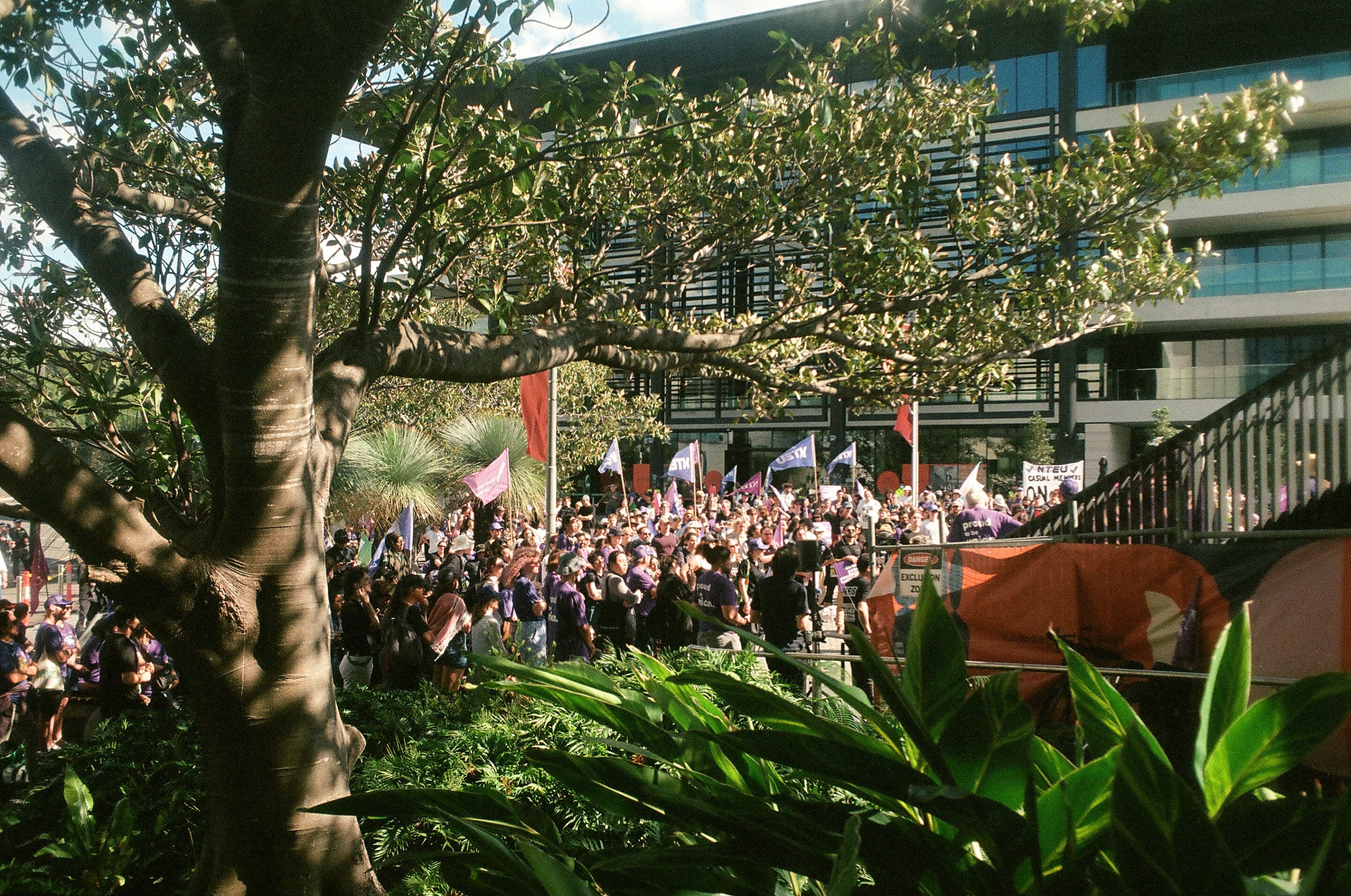
The Bargaining Team were particularly interested to see how the week’s bargaining would progress given the threat of strike on Wednesday next week (2nd September). The Branch President scheduled a special branch committee meeting on Wednesday evening after bargaining. In the event that Management would make significant concessions on key issues, the Bargaining Team and Branch Committee were prepared to discuss the possibility of putting a motion to members to call off the strike and picket.
As it eventuated, this was not necessary. Management missed an opportunity to resolve key sticking points. The progress made at the table was insufficient for the Bargaining Team to make that recommendation for the Branch Committee to consider. Bargaining was not completely unproductive, as per the detailed report below.
However, the NTEU indicated that the requirements for several matters scheduled for discussion had not been met, and so the following important matters were substantially taken off the agenda:
- Schedule 1: Management has outstanding pieces of information that have been promised to the NTEU working group on this matter. As these were not provided by Tuesday, the NTEU called for bargaining on Schedule 1 matters to be deferred.
- Disability: the NTEU is waiting for management’s substantial response, but Management instead indicated they would only provide an update on a related policy moving through Management’s processes. The NTEU indicated that Enterprise Bargaining is not the Joint Consultative Committee (JCC, a quarterly consultation process attended by management and the Union) and that they expect Management to return on the substance of the clauses in the Enterprise Agreement.
- Decasualisation and proposed new categories of employment: Management tabled some additional explanatory material on Tuesday that the NTEU will consider. The NTEU reiterated to management, the key requirements members have set for the discussion of this topic (floor on balanced roles, no new categories of employment, genuine decasualisation). This was productive, but the Bargaining Team indicated that they are bound by the members’ motions not to negotiate outside of the realisation of those requirements. We hope to get a substantive response for our next meeting, but this conversation was truncated.
Additionally, and in the category of Bargaining-is-not-the-JCC, Management brought a PVC Teaching and Learning from the DVC (Education and Students) portfolio to complain about the characterisation of the AI green paper. This was given short shrift by the Branch President, who observed:
- The discussion was not related to the matter of the AI clauses proposed by the NTEU and should be referred to the JCC
- The DVCs office had ample opportunity to consult on the green paper with staff unions, and had not chosen to do so
- And that the claims in the paper – including the idea that the technology represents the largest change in the entire history of higher education, that teaching practices would substantially change as a result of its introduction, that the University would explore service automation, and that the core role descriptions of academic staff would be rewritten – clearly foreshadowing substantial changes.
The Team would also like to thank JL for their work in Bargaining over the last six months. JL has been called away to deal with some other matters but has been a valued member of the team that has contributed greatly to many important areas this bargaining round.
Bargaining Summary
This said, the Bargaining Team had quite full days during the week.
Over two days of enterprise bargaining discussions, several significant issues emerged. The first concerned amendments required by new gender-based violence legislation. While most debate centred on technical drafting, a key point of focus was management’s proposal to remove complaint-handling timelines from the Agreement. The NTEU argued that existing timeframes are essential to procedural fairness and do not prevent compliance with statutory resolution requirements, contending that delays are more likely attributable to institutional processes and resourcing than to Agreement provisions.
Artificial intelligence was another major focus. In response to prolonged disagreement, the NTEU presented a revised proposal aimed at regulating non-trivial AI applications through principles of transparency, accountability, consultation, human oversight, staff protections, training, and safeguards for Aboriginal and Torres Strait Islander cultural and intellectual property. The union maintained that meaningful protections are necessary prerequisites for a new Agreement.
On the second day, discussion centred on a proposed new employment category in the Veterinary School, academic and intellectual freedom, and academic workloads. Progress was made on protections ensuring that the exercise of academic and intellectual freedom cannot itself attract disciplinary consequences, although disagreement remains over how that freedom should be defined. Workload negotiations also advanced, particularly regarding weekly workload caps and mechanisms for oversight, but fundamental disputes persist over evidence-based workload policy and the resolution of contested workload allocation proposals.
Day 1: Tuesday 25 August
Excluding some of the matters discussed in the context, Tuesday largely focused on two matters.
The first was changes to the Agreement as a result of the new Gender-Based Violence laws. Members will know that unions like the NTEU have been engaged in the creation of these new laws to address the problem of Gender-Based Violence (GBV) on campuses, and the laws require universities make a number of changes to the way they deal with complaints, handle recruitment, and regulate consensual relationships at Universities.
The Union had some queries about additions to the Agreement that are technical, and largely related to variations of phrasing from the wording used in the new Code (which is delegated legislation under the Act). For the avoidance of doubt, the Union prefers to mirror the code text where it is brought into the Agreement
Contrary to some Management commentary that the Agreement has been the source of poor University performance in this area, and the fact that complaints handling has been something the NTEU has pushed management to improve for well over a year (see here for details) , the substantive matter for discussion was a management proposal to waive the right to timelines for complaints handing in the Agreement. The NTEU demonstrated at the table that the required timeframes – designed to ensure natural justice and procedural fairness for complainants and the accused – would not prevent the University meeting the 45-day timeline to resolve complaints (the Act also has exemptions for complex matters from this strict timeline). Management undertook to take this away and reconsider, but the NTEU would strongly argue that delays are often due to processes and resourcing, rather than the Agreement.
The second key issue at the table was Artificial Intelligence. This issue has been of increasing concern to members and the wider community, as it would seem that the era of laissez-faire approaches to the technology around the world is coming to an end. Following quite a number of unproductive sessions on this matter, the NTEU has proposed cutting though the stalemate with a substantially revised proposal that incorporates unions’ concerns, some of Managements’ key “red lines”, and variations of AI clauses from other agreements in the sector. This revision would:
- make clear the Union’s focus on AI regulation in the Agreement is focused on “non-trivial” applications
- set a standard for the use of AI (ethical, transparent, contestable)
- retain the use of change management for AI where there are significant impacts
- provide for consultation with staff for other forms of implementation of non-trivial systems
- retain human-in-the-loop, and accountability for autonomous systems
- protect staff image and voice
- provide a channel for concerns to be raised
- provide training
- protect Aboriginal and Torres Strait Islander cultural and intellectual property
The NTEU walked the parties through this revised position and hope for a substantive response at the next session. The Union has made it clear that the Union cannot accept a new agreement without staff protections.
The CPSU brought a matter to the table about overtime, looking to move overtime for public holidays to 3.5 times the base rate of pay.
Day 2: Wednesday 26 August
Three major issues dominated Wednesdays.
The first was a proposal – very late in the process – to create a new category of employment in the Veterinary School. The Union will be consulting with our members on this matter, but it is unclear the extent to which this proposal has had the same type of attention from Management as their others, with Management representatives effectively caucusing in real time across the table in response to some basic questions from the Union. Questions included:
- Whether these roles are needed, given discussions about changes to existing categories of employment (Management are not sure), and
- How many of these roles would be created (Management cannot provide a number).
Second, the NTEU returned to the issue of academic and intellectual freedom. This has been another recurrent topic, but unlike AI where the issue remains very ambiguous, there have been some points of agreement in the discussions of this issue, in addition to areas where the parties are at loggerheads. A few minor wording matters were in-principle agreed on Wednesday.
Importantly, the Union appears to have achieved a commitment from management that the use of academic and intellectual freedom from staff cannot result in disciplinary punishment nor have a negative impact on employment or career advancement. This would be explicitly worded in the Agreement and would resolve the ambiguity of the existing set of words.
This is predicated on what academic and intellectual freedom is, and readers will know from previous work in this space that the union would like a clear statement that academic and intellectual freedom governs the distribution of ideas, and the expression of views, in a ethical and professional way. Management retain a preference to include a more sweeping provision about “responsible” exercise of such freedom and want those thresholds to be held to the “highest” standards. This remains a point of negotiation and the Union will continue to probe if there is a way to navigate between these two positions. Clearly, the definition of a right to the freedom of expression gives effect to the new explicit protection.
The other key matter relates to the use of campus space, and Management wants to write a reference to policy (the CAP) into the Agreement. The Union does not want this included, as policies can be changed at a whim by Management, and we need a clear articulation on the use of space.
Finally, academic workloads returned to the table. This was another productive discussion, but the matter remains far from resolved.
Significantly, the parties appear to have agreed that, with a clarification of wording, the maximum workload allocation for any individual week for academic staff can bet set at 45 hours, and this might resolve that problem predominantly experienced by Education Focused staff, namely that their workloads during semesters can create periods of excessive and unmanageable teaching and making combinations. This has been a long journey, subject to considerable discussion early in bargaining, and the possible resolution of this is a minor (in Agreement terms) but important (in human terms) outcome. Some agreement was made around matters associated with the work of the Academic Workload Monitoring Committee, and the Union put forward counter proposals around the issue of collective workload allocation and clarified a concern of Management that might smooth the way to finalise that element of this issue (this has implications for a similar proposal for professional staff, so resolving this will assist the Union’s claims for professionals staff).
We continue to be at loggerheads on the basic proposition that workloads policies need to be based on evidence. Bonkers.
The parties discussed in detail the issue of unresolved Workload Allocation Policies. Management proposed a mechanism to resolve these that would effectively permit Deans to maintain the status quo indefinitely (formalising the current problem where a Dean does not want to put forward a new WAP that would be voted up by the staff). The NTEU diagnose this problem having three elements:
- the basis on which the policy is designed
- the composition of the Collegiate Committee and whether that is representative or not, and
- a mechanism to resolve contested proposals
The solution to the problem might be realised through action in one or more of these three areas.
The NTEU undertook to take away the various proposals and revisions and rework these, particularly with regards to the last point.
The CPSU brought to the table a proposal for a new schedule specific for Protective Services management personnel to resolve scheduling and payment problems for 7-day 24-hour workers in those control rooms.
Next time
We’ll be back at the table in a fortnight, and the NTEU has proposed that we spend a day doing professional staff matters (an “omnibus” day) – Wednesday 9th. On the Tuesday, we have proposed to bring back for possible resolution: change management, AI, disability, workloads, and decasualisation.