
Week 6: June
Summary
This week’s bargaining felt like the end of the opening phase and the beginning of active negotiation. The Union pushed for movement beyond the familiar pattern of issues being heard and parked for later consideration. The most substantial discussion centred on disability and chronic health conditions, where the Union outlined a significant modernisation of the Agreement based on the social model of disability. While management appeared receptive to many of the principles raised, no commitments were given to include anything in the Enterprise Agreement. Further, management has indicated opposition to any additional leave being included in the Agreement for staff with disabilities or chronic health conditions, although questions remain around practical issues such as leave entitlements and implementation mechanisms.
Wednesday’s discussions focused on union rights, artificial intelligence, and the Professional Staff Development Fund. AI remains one of the more significant challenges in this round of bargaining. While management acknowledged many of the Union’s concerns around governance, worker data capture, employment impacts and accountability, there remains noticeable reluctance to embed protections in the Agreement itself. By contrast, discussions around increasing the Professional Staff Development Fund were constructive, reflecting broad recognition of its value and growing demand among staff.
Setting the Tone: The End of the Beginning
The week’s bargaining began with a preamble from the NTEU about the progress of bargaining and the stated desire of all parties to resolve bargaining by the end of 2026. We also reported on deliberations at our most recent general members meeting regarding the Decasualisation proposals distributed to all staff in the last two weeks.
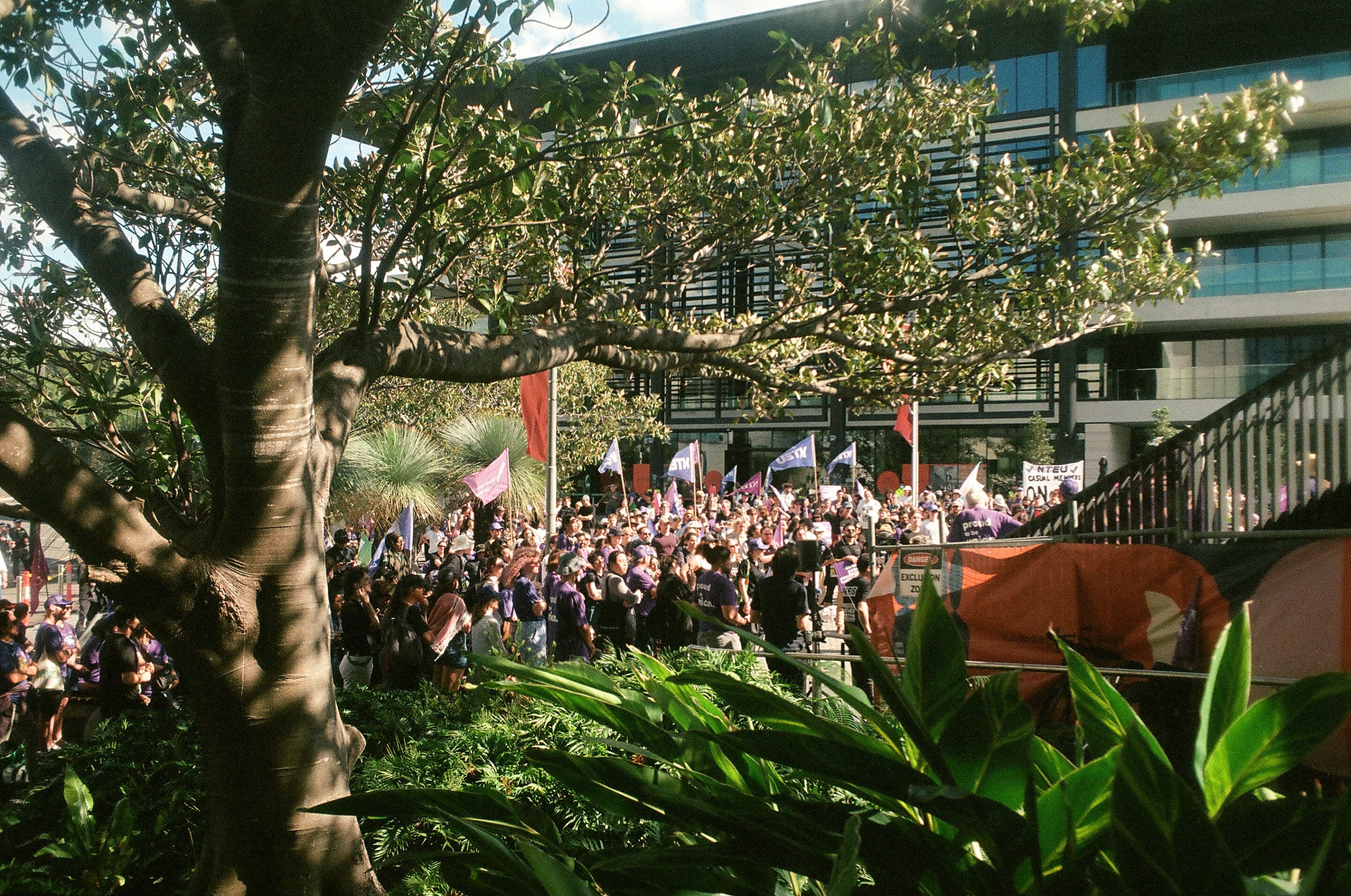
Inspired by the productive bargaining by Aboriginal and Torres Strait Islander members and management in the last session, the Union expressed ourdesire to achieve concrete progress on matters raised to date. In particular, we expressed our desire to move toward active bargaining to reach areas of agreement in-principle so that final clause drafting can progress. Readers will know we have highlighted a tendency to hear and park issues for later consideration by management. So in a show of good faith, the Union brought back our union rights and resources clauses to the table for active resolution (see below).
Tuesday: Disability and Chronic Health in the Spotlight*
Following the preamble, the Union got stuck into our paper on disability. This is one of the few items in our log of claims where the Union did not lead with the provision of draft specific clauses. Instead, weused a position paper to allow for more robust discussion around key definitions and principles that would then allow the parties to agree to draft agreed clauses around those key points.
The reason for this divergence from our normal bargaining approach lies in the holistic and significant nature of the claim being made: the Union is attempting to significantly modernise the agreement’s treatment of disability and chronic health – a key part of this being the embrace of the “social model” of disability. In this model, disability is not purely about having specific categories of diagnosis, but is about what people need to be able to thrive in their workplace and overcome barriers to participation. This would explicitly include episodic, invisible, fluctuating, and context-dependent conditions, and ensure staff do not need to identify as “disabled” to access protections and support.
The adoption of a model like this would position the University as a sector leader in supporting staff with disability and chronic illness. This was an important discussion, framing the more specific elements of our proposed Agreement modernisation. This included discussion of the implications for the provision of accommodating supports for staff, workload planning, performance and development, flexible work approvals, and the way the University uses Independent Medical Examiners to assess adjustment claims and medical termination of employment. Particular areas of discussion focused on issues of leave for people who have chronic health conditions and disability needs and the way the Disability Inclusion Action Plan can be resourced, reported on, localised, and subject to implementation oversight.
The Bargaining Team considered this discussion to be productive. Management agreed with many of the key principles put forward and asked to see Union draft clauses for reference(?). Some elements of the discussion revealed differences of opinion – such as over the question of a specific quantum of leave for managing disability and chronic health. However, in these areas management proposed alternative mechanisms that might address some of the concerns raised by the Union.
While this discussion dominated the Tuesday bargaining session, the CPSU introduced and discussed their claim related to conditions that effect reproductive systems – a claim supported by the NTEU. This claim has overlaps with our flexible work and disability and chronic health leave interests, and there is the possibility that this claim will be folded into our drafting with mutual satisfaction of both unions.
* The Tuesday bargaining session was slightly shortened as the NTEU had to appear before the Fair Work Commission to present our case in our dispute over implementation of the current Agreement’s decasualisation clause.
Wednesday: Union Rights and Resources, AI, and Professional Staff Development Fund
Wednesday was a big day of bargaining with a lot on the table.
Following the Acknowledgement of Country, the Union kicked off by bringing our Union Rights and Resources claims back to the table with the desire to achieve in-principle commitments on the clause. The Union had previously presented our proposal in detail and had received responses from management that expressed concerns about every item put forward and their proposed draft clause rejected several of our claims. In line with our commitment to bargaining productivity and good faith, the Union offered to retain the status quo on three of the claims originally presented and simplify a fourth, inviting management to agree to increased and clarified work time release for Union Officers, protect the rights of the Union to distribute union information on campus, bring elements of the Fair Work Act (delegate rights) into the Agreement, and formalise the current temporary arrangement allowing the Union to email all staff on matters of their industrial interest. In the latter, the Union proposed additional measures to protect against misuse.
This produced an active back and forth, and the parties committed to bring the issue back to the table in the next section for a more final resolution – this will be an important test of all parties capacity to bargain productively towards a proposed Agreement that can be voted on at the end of the year.
Following this, the parties spent the majority of the rest of the day talking through our respective AI proposals. The NTEU has the most detailed proposal, and one that brings a definition of AI into the Agreement, places our core values for AI in the document (use of AI in the public interest, comprehensible and contestable), prevents the replacement of human decision making and employment by technology, includes informed consent for the use of staff behavioural data, and brings a governance arrangement for AI adoption into the agreement. The CPSU’s detailed clauses have similar elements and there is a degree of overlap, but the NTEU would support their additional suggestions around staff training and environmental considerations.**
The Branch has anticipated that the issue of AI regulation will be one of the more difficult matters to progress. This is based on experience over the last 14 months where the Union has attempted to engage management over issues of AI governance but been largely rebuffed. While many of the concerns and principles raised by the Union and our Subject Matter Expert were accepted and agreed by the University, there is clearly resistance to putting our concerns in the Agreement. Management have, however, undertaken to take the suggestions away and develop a formal response; but the Bargaining Team advises members that this issue is a very important one with the possibility of considerable implications on employment, work intensification, workplace surveillance, the moral rights of authors, and the cultural rights of Aboriginal and Torres Strait Islander people. This is a key issue to watch.
Finally, the parties discussed the Professional Staff Development Fund. Members might recall that this Fund was established in a previous Enterprise Bargaining round following agitation by the NTEU at the end of bargaining to get a “bump” for professional staff – the Fund’s aim is not to support training associated with staff’s current role, but for the purposes of development and promotion to higher positions.
While promotion and utilisation of the Fund got off to a slow start, the work of all parties (unions and management) over the last few years has now seen the Fund being oversubscribed. As a result, the CPSU put forward a proposal to increase the “pot”, something the NTEU supports. This will be subject to more discussion, the value of the Fund to the University’s “human capital” is something that most managers accept and the promotion of the fund by line managers to their staff is often a sign of good local line management practice.
** Last Friday the NTEU informed management we consider their proposed Sustainability Program Control Board may violate clause 540(c) of the Agreement in failing to include Union nominees.